
Key Points
Canada has been an interesting market to watch during Google’s AI Overview rollout — partly because the rollout happened in waves that affected Canadian search results differently than US results, and partly because Canadian SEO practitioners have had to develop specific approaches to a shift that’s reshaping how organic search traffic flows in every market…
Canada has been an interesting market to watch during Google’s AI Overview rollout — partly because the rollout happened in waves that affected Canadian search results differently than US results, and partly because Canadian SEO practitioners have had to develop specific approaches to a shift that’s reshaping how organic search traffic flows in every market it touches.
The agencies that have navigated this well share some common characteristics. They saw the shift coming. They adapted their client strategies before the traffic impact became undeniable. And they’ve developed specific methodologies for the AI Overview era that go beyond what worked in the pre-AI-Overview search landscape.
Here’s what those adaptations look like.
Understanding What Changed for Canadian Search
AI Overviews appeared in Canadian Google search results beginning in 2024 and have expanded significantly since. The categories of queries most affected align broadly with what’s been observed in the US market: informational queries, research-phase commercial queries, comparison queries, and question-format searches.
For Canadian SEO specifically, there are some nuances worth noting. Canadian Google search has historically had somewhat different results from US search, reflecting different local signals, different content availability, and different competitive landscapes. The AI Overview rollout has increased the degree to which Canadian search surfaces synthesised answers that draw from global sources — meaning Canadian-specific content has had to become more explicitly positioned to compete for inclusion in AI-generated answers that draw from a broader international pool.
The bilingual dimension of Canadian search adds complexity. French-language AI Overviews in Quebec behave somewhat differently from English-language ones, and the content standards required for AI inclusion in French-language search have required specific attention from agencies serving Quebec markets.
The Traffic Impact Analysis
The most immediate practical challenge for Canadian SEO agencies following the AI Overview rollout has been honestly accounting for the traffic impact in client reporting and strategy.
Organic sessions from informational queries have declined for many Canadian clients, as AI Overviews intercept searches that would previously have resulted in clicks to organic results. This decline is real, measurable, and in some categories significant.
The agencies that have handled this well have been transparent with clients about what’s happening, connected the traffic change to the broader shift in search behaviour, and pivoted the strategy conversation from “how do we get more traffic” to “how do we ensure we’re visible and cited in AI-generated answers as well as traditional organic results.”
Seo agency canada operations that tried to explain declining informational traffic as a temporary fluctuation or a technical issue have lost client trust when the pattern persisted. The ones that provided clear, honest analysis of what was driving the change, and proposed concrete responses, have strengthened their positioning as strategic advisors rather than tactical implementers.
The Content Architecture Response
The content strategy response to AI Overviews in Canadian markets has involved a specific shift in how content is structured and what questions it’s designed to answer.
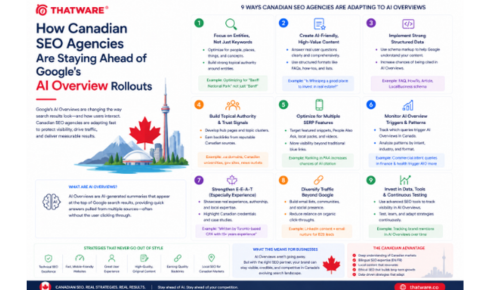
Content for AI Overview inclusion requires: clear, direct answers to specific questions at the beginning of the content (not buried in the middle); accurate, well-attributed factual claims; a clearly established credibility context; and structured data that communicates the content’s topical relevance to answer engines.
Many Canadian businesses had content libraries built for the previous search paradigm — comprehensive, SEO-optimised long-form content that was well-suited to the traditional ranked result model. Adapting this content for AI Overview inclusion has been one of the primary content strategy activities for best seo agency canada operations over the past twelve months.
This isn’t replacing the existing content architecture — it’s augmenting it. Adding clear question-and-answer sections to existing comprehensive content, restructuring introductions to lead with direct answers, and adding FAQ schema markup to appropriate pages. The combination of comprehensive content (which still drives traditional ranking performance) and AI-Overview-optimised content architecture (which supports inclusion in AI-generated answers) serves both paradigms simultaneously.
Entity and Authority Building for AI Inclusion
One of the clearest signals from observing which brands appear consistently in Canadian AI Overviews is that entity recognition and authority signals matter significantly — in some ways more than traditional link-based authority.
Brands that are well-established as entities in Google’s Knowledge Graph, that have comprehensive and accurate structured information across authoritative sources, and that have earned editorial citations from high-quality Canadian and international sources appear more consistently in AI Overview responses for relevant queries.
The practical implication for Canadian agencies has been incorporating entity optimisation — Knowledge Graph management, Wikipedia and Wikidata presence, consistent entity information across authoritative directories — into standard strategy rather than treating it as an advanced or optional layer.
Canadian businesses that have invested in this entity infrastructure are finding it pays dividends both in AI Overview visibility and in traditional search, where entity recognition has been an increasingly significant ranking signal.
Measurement Adaptation
The measurement frameworks that Canadian agencies have adapted for the AI Overview era reflect the need to measure a broader picture of organic visibility than traditional rank tracking provides.
Adding AI Overview appearance monitoring to the standard measurement stack — systematic auditing of which queries trigger AI Overviews and whether client content is cited — has become standard practice for the agencies doing this well.
Share of voice in AI-generated answers, tracked manually through query sampling and increasingly through emerging tool integrations, is becoming a performance indicator that sits alongside traditional ranking and traffic metrics.
The agencies that have invested in building this expanded measurement capability can have genuinely better strategic conversations with their clients — demonstrating not just where they’re visible in traditional search but where they are and aren’t visible in the AI-mediated search experiences that are capturing a growing proportion of search interactions.
Looking Forward
The Canadian market will continue to be shaped by the AI Overview rollout as Google extends coverage to more query categories and refines the content quality signals that determine AI inclusion.
The agencies that will navigate this best are the ones treating it as a sustained strategic evolution rather than a one-time adaptation. The fundamental principles — building genuine topical authority, producing content that directly and accurately answers user questions, establishing strong entity representation — are durable across search paradigms. The specific implementation adapts as the landscape evolves.
For Canadian businesses working with SEO agencies, the right question to ask is not “how are you dealing with AI Overviews” but “how has your strategy evolved in response to the changes in Canadian search over the past twelve months?” The quality of the answer reveals whether the agency is genuinely staying ahead of the shift or simply reacting to it.
Related Posts

Rain Detector: Enhance Safety and Innovation with an Electric Bike Motor
In the world of electronics and modern transportation, integrating technology for safety and…

Why Activating with a Code Matters for Peacock TV
Peacock TV, NBCUniversal’s streaming service, has rapidly grown in popularity due to its…

How to Ensure Scalability and Stability in Micropayment Systems Using Cloud Infrastructure
Setting the Scene In a world where convenience drives digital innovation, micropayments—small-value transactions…
