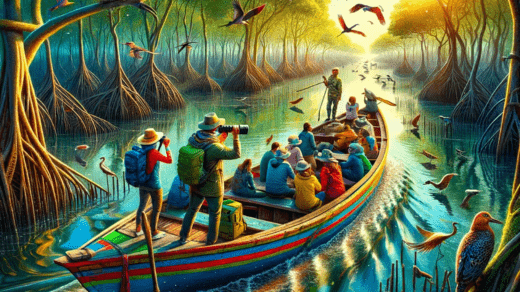
Some places aren’t just destinations; they’re experiences that seep into your bones and stay long after you’ve left. The Sundarbans — that sprawling mangrove forest stretching across India and Bangladesh — is one of them. It isn’t about five-star luxury, flashy tourist spots, or carefully curated backdrops. It’s about mud and tide, about stillness and waiting, about glimpses of life that make you realize how fragile, and how powerful, nature really is.
I remember the first time I set foot on one of those creaky boats. The sun was already blazing, the water glinting in sharp flashes, and the air carried a thick scent of salt and earth. The channels all looked the same, twisting like veins across the delta, and yet each turn felt like a story waiting to unfold. That’s the charm of a Sundarban trip: it doesn’t offer neat beginnings or endings, just the feeling of being folded into a vast, untamed world.
The Forest That Breathes
The Sundarbans isn’t like other forests where paths are carved for you. Here, the tides dictate everything. The mangroves rise from the mud in strange, contorted shapes, their roots clutching the earth like gnarled fingers. It feels alive — not in some poetic sense, but literally alive, breathing with the ebb and flow of the sea.
Everywhere you look, there’s a hint of movement. A kingfisher flashing its neon wings. A mudskipper wriggling between water and land. Crabs waving their oversized claws like tiny flag bearers. And just when you think it’s all quiet, the water stirs — maybe it’s just a fish, or maybe it’s something much bigger lurking underneath.
The Famous and the Hidden
Of course, the Royal Bengal Tiger is what most people come chasing. There’s a thrill in knowing that, somewhere behind that thick wall of mangroves, one might be watching you. But truth be told, few visitors ever see it. And that’s okay. Because the Sundarbans isn’t about guarantees; it’s about possibility.
One moment it’s silence, the next it’s broken by the splash of a crocodile sliding into the river. Sometimes a pod of dolphins will surface alongside your boat, playful and sudden, as if reminding you that magic here doesn’t arrive on schedule. The forest doesn’t perform — it reveals, if you’re patient enough.
Lives on the Edge
Beyond the wildlife, what struck me most were the villages scattered at the margins of this wilderness. Life here is tough, unforgiving even. Homes are perched on stilts to survive floods. People farm on salty soil, mend fishing nets, and prepare for storms that seem to arrive every season.
Yet there’s resilience in their rhythm. Kids laugh and chase each other barefoot along muddy paths. Women dry fish in the sun while men set out at dawn in slender boats. These communities don’t just live near the Sundarbans; they live with it, negotiating daily with tides, storms, and predators. Meeting them reminded me that travel isn’t only about landscapes — it’s about people who give those landscapes context.
Evenings on the Water
There’s something oddly comforting about nights in the Sundarbans. The boat anchors, meals are simple but hearty, and the world shrinks into shadows and stars. The silence isn’t empty; it’s full. Crickets sing, water laps gently against the hull, and the mangroves stand like sentinels in the dark.
It’s the kind of quiet you rarely get in everyday life. The kind that doesn’t just surround you but seeps into you, slowing your thoughts, making you notice the little things — the reflection of the moon on rippling water, the breeze brushing your skin, the occasional splash of unseen movement.
Forget the Checklist
If you approach the Sundarbans with a checklist, you’ll leave disappointed. No, you can’t schedule a tiger sighting at 3:15 p.m. And no, the dolphins won’t leap on command. This isn’t a safari park, and that’s precisely what makes it unforgettable.
Here, the joy is in the waiting. The forest teaches you to let go of control, to sit still, and to appreciate what reveals itself in its own time. Sometimes the waiting itself becomes the experience — a lesson in patience that feels oddly refreshing in our over-scheduled lives.
Finding the Right Path
Not all journeys into the Sundarbans are the same. Quick day trips from Kolkata are common, but they barely skim the surface. If you can, stretch your stay into two or three days. That’s when the place really begins to sink into you. You start to notice the subtle shifts of the tides, the way mornings feel different from afternoons, how the forest seems to hold its breath at dusk.
This is where choosing wisely matters. A good Sundarban travels experience isn’t about glossy promises; it’s about guides who respect the forest, boats that feel safe but not overdone, and itineraries that give you time to breathe instead of rushing you from one spot to another. Sustainable operators who work with local communities often offer the richest, most genuine insights.
When to Go and What to Bring
If you want the Sundarbans at its most welcoming, winter — November through March — is your window. The weather is kinder, the skies clearer. Summers are heavy with humidity, and the monsoons bring unpredictability, flooding, and sometimes danger.
Pack light but smart. Cotton clothes, sunscreen, a hat, insect repellent — the essentials. Binoculars are worth carrying, especially if you’re drawn to birds. And bring patience. Really, it’s the most useful thing you’ll pack.
More Than a Trip
What lingers after leaving isn’t a single sight or moment. It’s the sum of it all — the mud, the silence, the resilience of the people, the flashes of wildlife, the rhythm of tides that couldn’t care less about human schedules.
The Sundarbans teach you humility. They remind you that there are still places where nature writes the rules and we are merely visitors. And that realization — that gentle knocking down of our self-importance — is perhaps the greatest gift the forest offers.
Closing Thoughts
Travel doesn’t always have to dazzle you with spectacle. Sometimes, it just has to remind you how small you are in the grand, messy, beautiful scheme of things. The Sundarbans do exactly that.
You may come back without tiger photos. Your shoes might still be caked in mud. But you’ll carry home something subtler, more enduring: perspective. A sense that, for a few fleeting days, you belonged to a world that still refuses to bend to human control.
And honestly, isn’t that the point of traveling in the first place?